Beds and seed math
How Many Seeds Do I Need? Why Grid Planting Grows More Cut Flowers
In my first season, I ordered seed based on what felt right. For some flowers I ended up with way too many seeds, enough to share with the whole neighbourhood. For others I didn't order nearly enough, and I was scrambling at the last second trying to find more. That's harder than it sounds up here, because most seed sold locally isn't meant for cut flowers. So I'd end up ordering from the US or from small flower farms across the country, and then waiting on the mail.
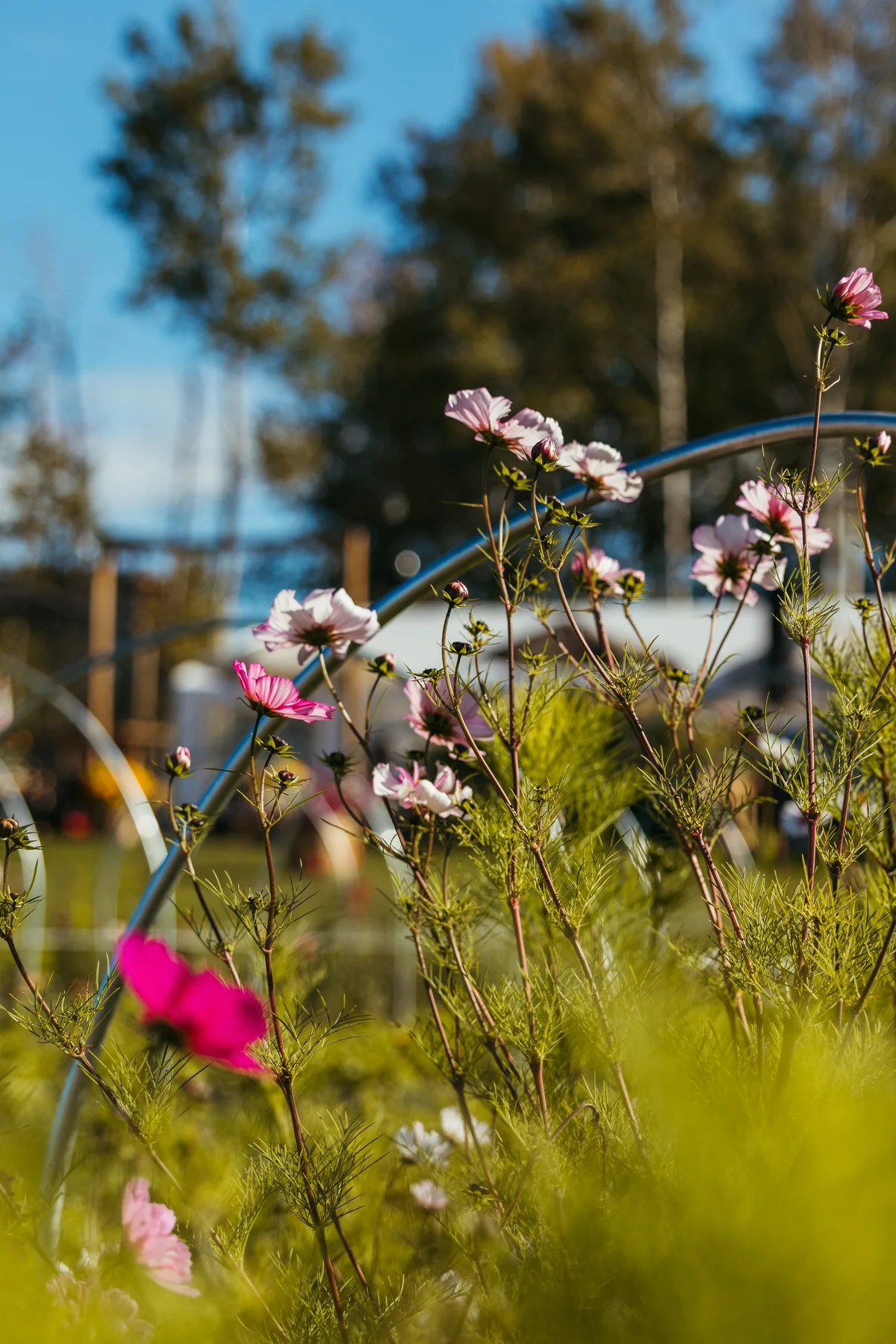
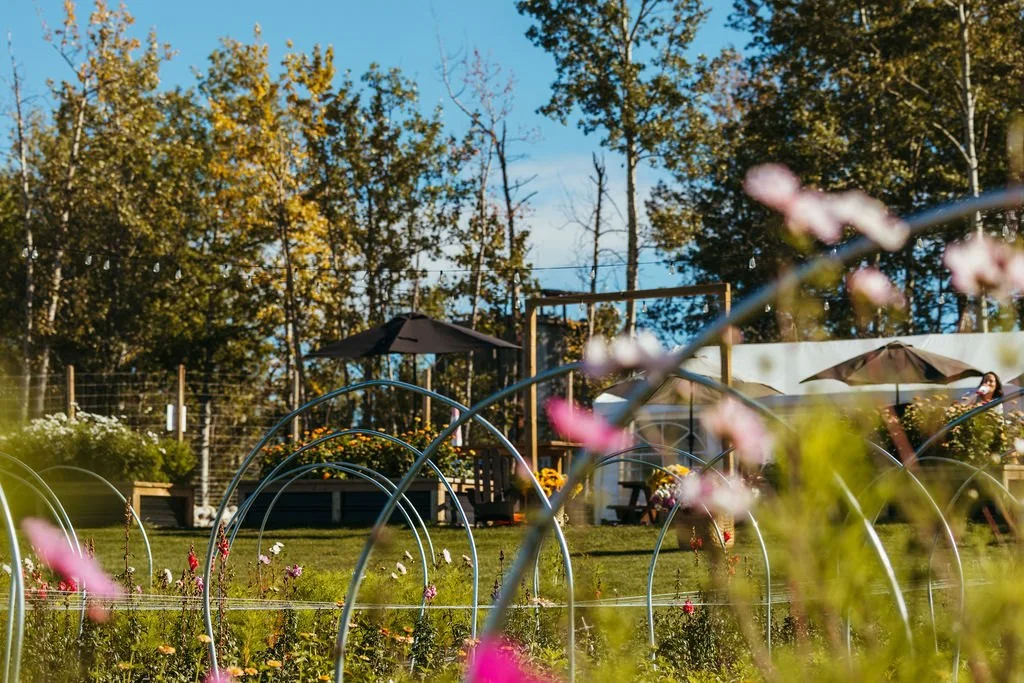
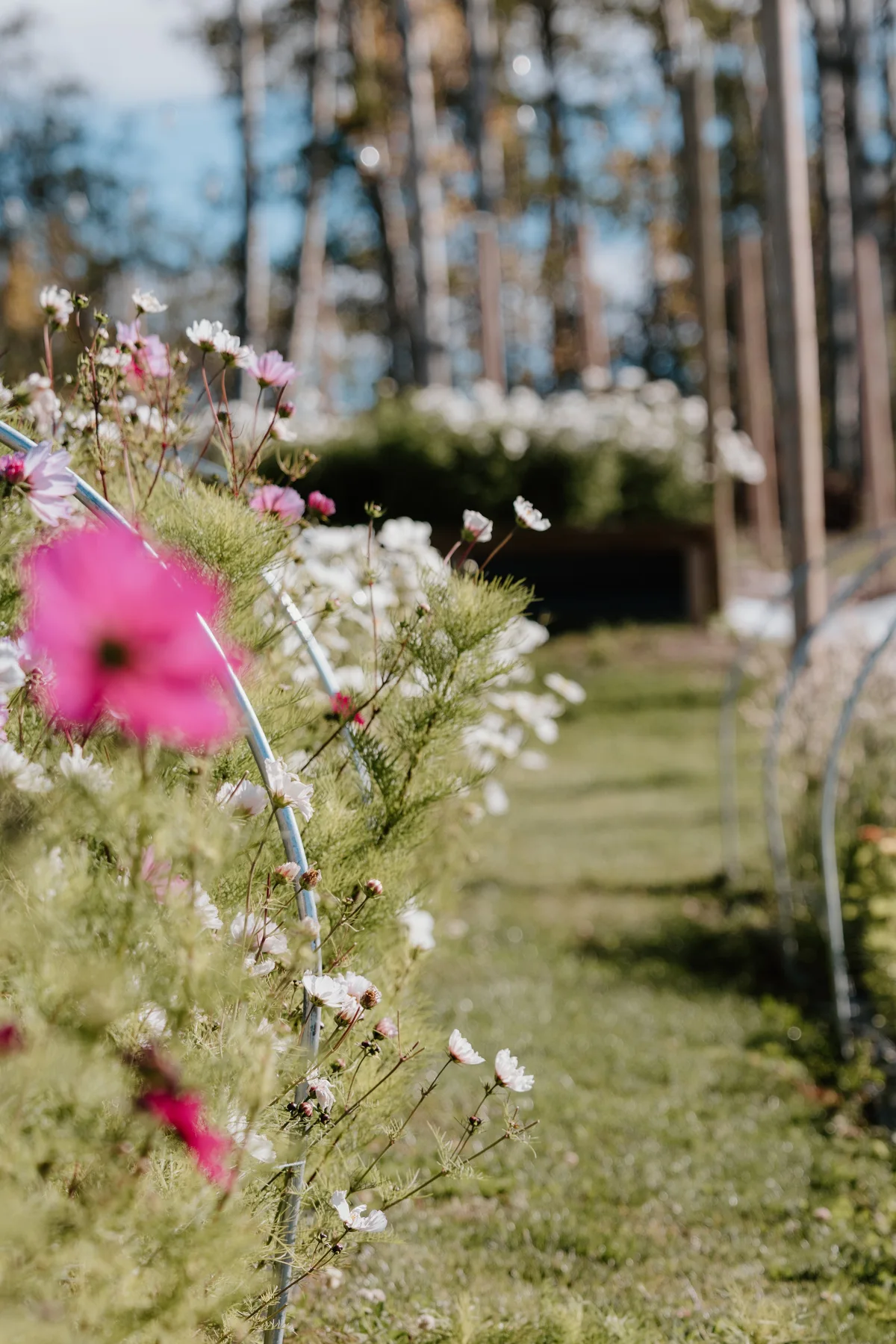
Layout was the one thing I did get right early. When I started planning my first flower farm, I knew I wanted to get as many flowers as I possibly could in the space I had, so I researched that. The research said planting in long horizontal rows was old school, and I was introduced to planting in a grid. Game changer!
The thing is, a seed packet can't tell you how many seeds you need. It has no idea how big your bed is or how close cut flowers should be planted. That part is up to you, and it starts with how you lay out your bed. (If you haven't chosen your seed yet, start with Cut Flower Varieties vs Garden Varieties.)
Why do cut flower growers plant in a grid instead of rows?
Because a grid grows far more flowers in the same space. University of New Hampshire Extension sums up the old way: "More traditional gardens consist of long, single rows of vegetables spaced widely apart." All that space between rows is soil you're not picking from.
In a grid, you plant the whole bed, with each plant the same distance from its neighbours in every direction. UNH Extension's advice for beds is to "use equidistant spacing between plants." For cut flowers, that's the key, because what matters is how many flowers you pick from each square foot of bed. Kansas State University's guide for cut flower growers says it plainly: what counts is "the number of flowers produced per square foot of bed space and not the number of flowers per plant." They also found that "A closely spaced crop of annual flowers will usually produce more flowers over the growing season than a crop at wider spacing."
How many more flowers fit in a grid?
A lot more. Here's the math for one 4 by 8 foot bed of flowers planted 9 inches apart, the spacing we use most on our farm:
| Layout | Plants in a 4 by 8 foot bed | Compared with one row |
|---|---|---|
| One row down the bed | 10 | |
| Two rows, 2 feet apart | 20 | 2 times |
| Square grid | 50 | 5 times |
| Honeycomb grid | 60 | 6 times |
Same bed, same soil, same water. You're just using all of it.
Our own beds are 4 feet wide and 60 feet long. Planted in a single row at 9 inches, one bed would hold 80 plants. In our 9-inch honeycomb grid, it holds about 477.
What does that look like on an acre?
Here's where it gets exciting. Picture one acre planted the traditional way, in rows 2 feet apart with plants 9 inches apart in the row. That's about 29,000 plants.
Now picture the same acre in 4-foot beds with 18-inch paths between them, just like our flower field, planted in a 9-inch honeycomb grid. That's about 65,000 plants. One acre planted in a honeycomb grid holds about as many plants as 2 acres of traditional rows.
One honest note: more plants doesn't always mean the same number more flowers. Plants spaced closer may each give you a few fewer stems. Kansas State says a closely spaced crop "will usually produce more flowers," but every flower and every garden is different. What doesn't change is that you're weeding, watering and walking a whole lot less ground for every plant you grow.
What is honeycomb planting, and why does it fit even more?
Honeycomb planting is a grid where every other row shifts over by half a space, so each plant sits in the gap between two plants in the next row. On our farm we use honeycomb planting for some of our flowers at 9 inch spacing.
It fits more plants because the rows can sit closer together while every plant stays the same distance from its neighbours. A 2022 review of planting arrangements in the journal Horticulturae puts it this way: "If the distance between rows and plants remains the same, the hexagonal system could accommodate 15% more plants than the square system." Hexagonal is the scientific name for honeycomb. (The geometry behind it: the rows sit about 87% as far apart, so you fit about 15% more.)
In our 4 by 8 foot bed at 9 inches, a square grid holds 50 plants. A honeycomb grid holds 60.
What's the science behind grid spacing?
It comes down to sharing. When every plant is the same distance from its neighbours, each one gets a fair share of light, water and nutrients. The same review explains that "Equidistant inter- and intra-row spacing provides soil coverage that is earlier than other distances, thereby more sunlight is intercepted by the foliage."
That early cover does a second job. UNH Extension found that once plants are close enough, "they will shade the soil and prevent the growth of many weed seedlings." Less bare soil means fewer weeds and less water lost to the sun. And because you work from the edges of a bed instead of walking between rows, UNH notes you're "reducing the incidence of compaction caused by walking on the soil."
Is there such a thing as too close?
Yes, and this is the but. The review notes that adequate space between plants "will reduce competition for light, will conserve water, and will provide more soil nutrition to each plant." Squeeze too many in and they fight for all three. Kansas State warns that closer spacing also "reduce[s] air circulation within the bed," which can invite disease.
Spacing changes the flowers you get, too:
- Sunflowers. Utah State University Extension recommends 4 to 6 inches apart for single-stem sunflowers and 18 to 24 inches for branching types. At 2 to 4 inches, blooms come in at 2 to 3 inches across. At 4 to 6 inches, they grow to 4 to 5 inches. Too tight, and Utah State says plants give "poor-quality blooms with weak stems" and are more likely to fall over in the wind.
- Snapdragons. Cornell University grows them at "high density (eg. 4 x 4 in.) for a once-over harvest of single stems," or 9 by 9 inches or wider to cut main stems and side stems over a longer season.
- Zinnias. University of Florida IFAS Extension found narrow spacing is best for a single harvest, and wider spacing is better for multiple harvests.
So the right spacing depends on the flower and how you want to cut it. One cut of single stems can go tight. Cut-and-come-again flowers need room to branch.
How do I work out how many seeds I need?
Once you know your spacing, the seed math is four steps:
- Count your plants. Work out how many plants fit in your bed at that flower's cut flower spacing, in a grid or honeycomb.
- Check the germination rate. Use the rate on your seed packet, or test it yourself (more on that below).
- Divide. Plants divided by germination rate tells you how many seeds will give you that many seedlings.
- Add a little extra. Some seedlings won't make it to the bed, so plan for a few more.
Here's how it works for our 4 by 8 foot bed in a 9-inch honeycomb grid, which holds 60 plants. Say 8 out of 10 seeds sprout, an 80% germination rate. 60 divided by 0.8 is 75 seeds. Add 10% extra for losses and you're at about 83 seeds.
How do I test my seed's germination rate at home?
With a paper towel. Oregon State University Extension suggests placing 10 seeds an even distance apart on a damp paper towel and checking them after 5 to 10 days. If 7 to 9 sprouted, most of the seeds will likely do well. If 6 or fewer sprouted, Oregon State suggests trying newer seed. University of Alaska Fairbanks Extension says to count only the strong ones with a good root and shoot, and to work out your percentage from how many sprouted out of how many you tested.
This is especially worth doing with leftover seed. Seeds don't really expire, but they lose strength over time. University of Illinois Extension says annual flower seeds are generally good for 1 to 3 years, and older seed can still work "by sowing more seeds than recommended to make up for the ones no longer capable of sprouting."
How should I store leftover seed?
Cool and dry. South Dakota State University Extension says "Reducing humidity is the most-important factor in extending the life of seeds," with relative humidity below 60% best, and temperatures above 90°F will "greatly decrease the viability" of your seed. Iowa State University Extension suggests keeping seeds in their original packets inside a tightly sealed jar in the fridge or another cool spot. If you use the fridge, South Dakota State adds one tip: let the jar warm to room temperature before you open it, so moisture doesn't form on the seeds.
Does it change by zone?
The math is the same everywhere. What changes is the flowers you choose and how many rounds you plant.
In cold zones like mine, our season is short, so every square foot of bed counts even more. Grid and honeycomb planting let us grow more flowers in the weeks we have. You can see the real sowing dates I use in Charlie Lake on The Farm Journal: When to Start Cut Flower Seeds in Zone 3.
In the middle zones, you may get more than one planting of fast flowers like sunflowers, so do the seed math for each round.
In warm zones, long, humid seasons make airflow matter more. Don't go tighter than the flower needs, and remember Kansas State's warning about air circulation.
Cory's take
The research I've done says the biggest seed mistake isn't the seed. It's not knowing how many plants your bed really holds. Switching from rows to a grid was a game changer for how many flowers I could grow, and once you know your layout, the seed numbers make sense.
My strong opinion? Do the seed math one bed at a time, before you order. In my first season I didn't, and I was either drowning in seed or scrambling for more. Working all of this out by hand, bed by bed and flower by flower, is one of the reasons I created Stemwise.
Join the waitlist
Stemwise is a cut flower planning app made for where YOU grow. Join the Stemwise waitlist and you'll be the first to know when it opens.
Sources and further reading
- Alan B. Stevens and Karen L. B. Gast, Kansas State University, "Specialty Cut Flowers: A Commercial Growers Guide," MF-1034, 1992. https://bookstore.ksre.ksu.edu/pubs/MF1034.PDF
- Otho Wells (editor), University of New Hampshire Cooperative Extension, "The Vegetable Garden," Chapter 10. https://extension.unh.edu/sites/default/files/migrated_unmanaged_files/Resource003548_Rep5077.pdf
- M. Amdadul Haque and Siti Zaharah Sakimin, "Planting Arrangement and Effects of Planting Density on Tropical Fruit Crops: A Review," Horticulturae, 2022. https://www.mdpi.com/2311-7524/8/6/485
- Calee Garn, Alison Bingham, Melanie Stock and Claudia Nischwitz, Utah State University Extension, "Sunflower Cut Flower Production in Utah," 2026. https://extension.usu.edu/productionhort/research/sunflower-cut-flower-production-in-utah
- Cornell University, Cornell High Tunnels, "Snapdragon." https://blogs.cornell.edu/hightunnels/flowers/cut-flowers/cut-flower-crops/snapdragon
- Rick Schoellhorn, Everett Emino and Erin Alvarez, University of Florida IFAS Extension, "Specialty Cut Flower Production Guidelines for Florida: Zinnia," ENH 953, 2004. https://journals.flvc.org/edis/article/download/109358/104545/152684
- Oregon State University Extension, "Will Your Seeds Grow Plants?", 2021, updated 2024. https://extension.oregonstate.edu/node/236201
- Mingchu Zhang, University of Alaska Fairbanks Cooperative Extension, "Procedures for the Wet Paper Towel Germination Test," reviewed 2021. https://www.uaf.edu/ces/publications/database/gardening/procedures-wet-towel-germ.php
- Jan Phipps, University of Illinois Extension, "Is it okay to save unused seeds for the following year?", 2022. https://extension.illinois.edu/news-releases/it-okay-save-unused-seeds-following-year
- Aaron Steil, Iowa State University Extension and Outreach, "What is the best way to store left-over flower and vegetable seeds?", 2024. https://yardandgarden.extension.iastate.edu/faq/what-best-way-store-left-over-flower-and-vegetable-seeds
- South Dakota State University Extension, "How to Store Leftover Garden Seeds," 2024. https://extension.sdstate.edu/how-store-leftover-garden-seeds
Questions growers ask
Does grid planting really double my growing space?
In plant numbers, about. At 9-inch spacing, a honeycomb grid in 4-foot beds with 18-inch paths fits about 65,000 plants on an acre, compared with about 29,000 in traditional rows 2 feet apart.
How many seeds do I need for a 4 by 8 foot bed?
It depends on the flower's spacing. At 9 inches apart, a 4 by 8 bed holds 50 plants in a square grid or 60 in a honeycomb grid. Divide by your germination rate and add a little extra.
Is grid planting better than rows for cut flowers?
For most cut flowers, yes. Kansas State University says closely spaced annual flowers usually produce more flowers over the season, and what counts is flowers per square foot of bed.
How much more does honeycomb planting fit?
About 15% more than a square grid at the same spacing, according to a 2022 review in Horticulturae.
How far apart should cut flower sunflowers be?
Utah State University Extension recommends 4 to 6 inches for single-stem sunflowers and 18 to 24 inches for branching types.
Can I use last year's seed?
Usually, if it was stored cool and dry. University of Illinois Extension says annual flower seeds are generally good for 1 to 3 years. Do a paper towel test first and sow extra if the rate is low.
About the author
Cory Franklin
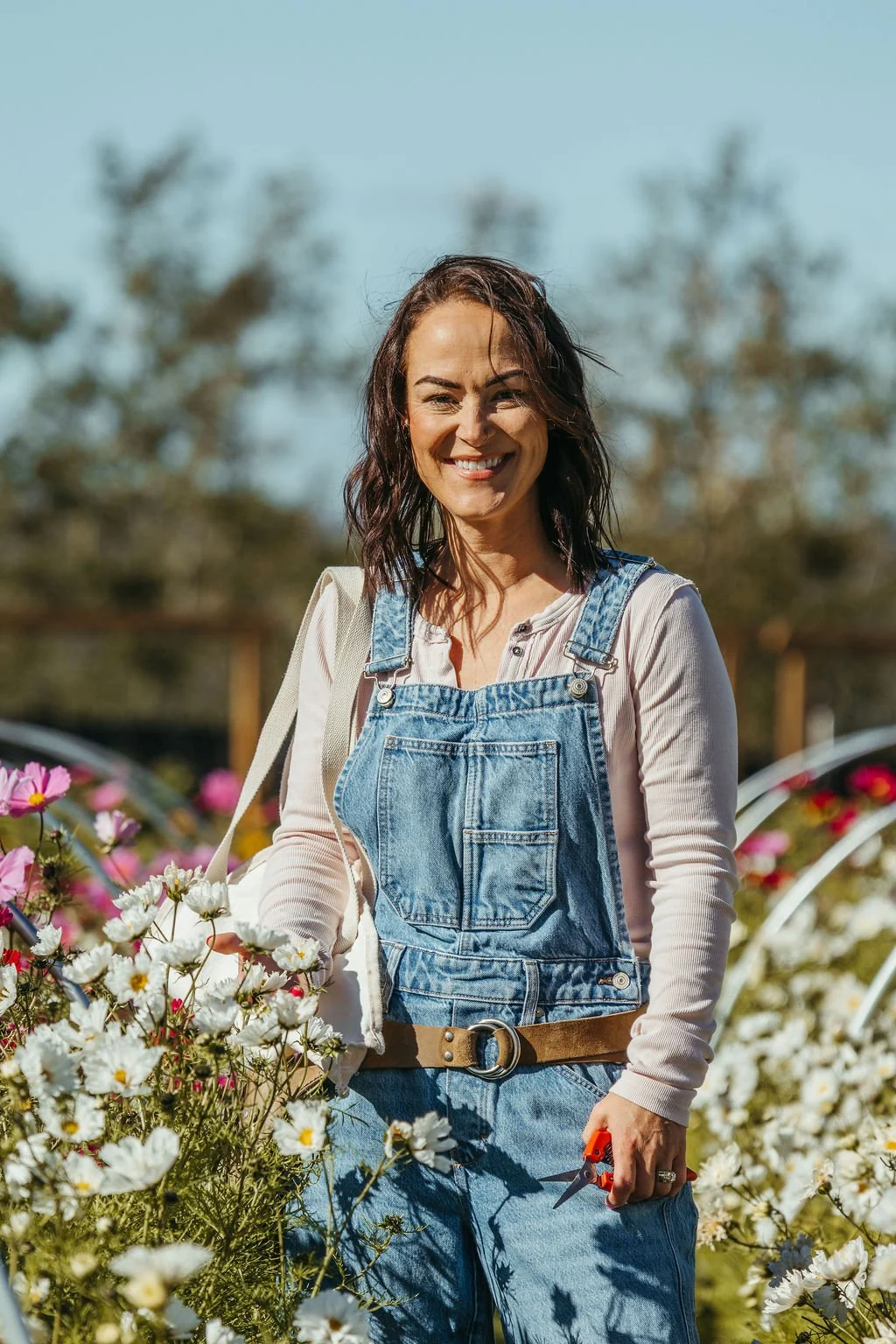
Cory Franklin grows cut flowers in zone 3 in northern BC.